


This blog series will delve further into the findings of the white paper and will also consider some wider questions. It is hoped that these insights will be useful in throwing some light on the evolving needs and preferences of an increasingly multigenerational travelling workforce.
Situ recently published a white paper, Mind the Gap: Generational analysis of the accommodation requirements and behaviours of today’s business travellers. The paper presented the key results of a combined research study comprised a survey conducted by YouGov1 and a series of interviews with senior corporate travel managers and specialists. It explored the increasingly diverse expectations, behaviours, and preferences across four generational cohorts of business travellers: Gen Z, Millennials, Gen X, and Baby Boomers.
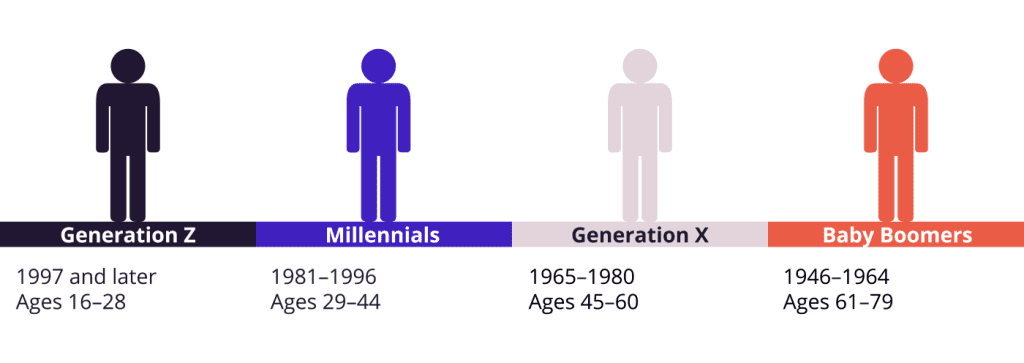
This post, part of Situ’s White Paper Insights Series, focuses on two research questions that aimed to discover where travellers of different ages are staying in urban, suburban or rural/ remote areas; and what type of accommodation they stay in when they travel.

Want to learn more? We hosted a webinar that delved into the key insights we uncovered in the white paper – with some of our interviewees as guests.
Where are business travellers staying, and for how long?
The survey question, ‘Where are you staying, and for how long?’ aimed to understand whether the four generations of business travellers were showing different patterns of travel to urban, rural/ remote and suburban areas and why this might be.
Key finding: Overall, the survey was consistent with known trends, with all ages travelling most to urban centres for short stays of between 1–3 nights. The data suggests that younger generations may be sent outside cities, with Gen Z and Millennial travellers taking longer trips when it comes to suburban and remote/ rural areas compared to older generations – this could be interpreted as consistent with more senior staff delegating longer assignments from above.
Urban:
- All generations stay for between 1–3 nights in urban areas far more for than any other length of time: 60% of Gen Z, 60% of Millennials, 55% of Gen X, and 39% of Baby Boomers.
- There is a spike in Gen Z travellers staying between 8–28 nights.
- No Gen X or Baby Boomer travellers reported travel to urban areas over 8 nights.
Suburban:
- Millennials stay longest in suburban areas (32%) followed by Gen Z (28%).
- Trips of between 4–7 nights and 8–28 nights are much more common for Gen Z travellers than any other age group.
Remote/ rural:
- Approximately double the percentage of Gen Z and Millennial travellers are staying in rural and remote areas between 1–3 nights compared to Gen X and Baby Boomers.
- More Gen Z are staying in rural/remote areas between 4–7 nights than any other generation combined.
What type of accommodation are business travellers staying in?
The next survey question we focused on was the type of accommodation that respondents stayed in during their stays.
When asked, ‘What type of accommodation do you tend to stay in when travelling for business?’ Gen Z and Millennial travellers report staying in three-star hotels or below more often than those in the generations above them, which chimes with traditional ideas that more senior employees expect and receive a higher class of accommodation.
Sector plays a role and can override preference, in that when employees in industries such as construction and engineering travel to remote areas where there are few hotels they will, of necessity, be staying in non-hotel accommodation such as single-family homes.
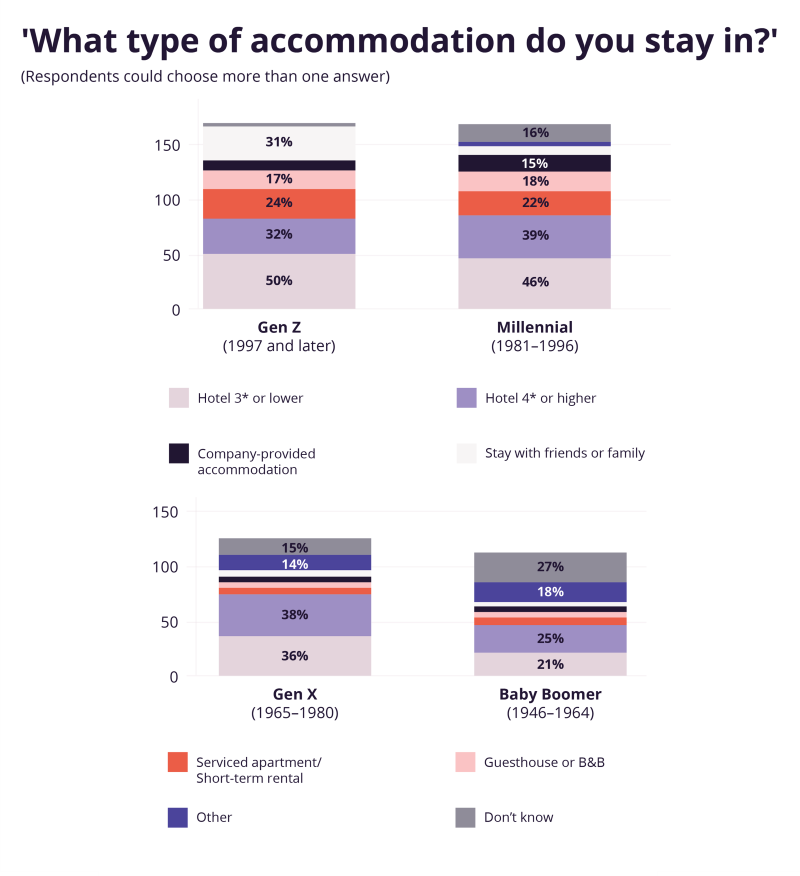
Both survey results and interviewees agree that Gen Z has started to favour non-hotel accommodation – serviced apartments, short-term rentals, and guesthouses or B&Bs – and even staying with friends and family. These decisions are likely to be driven by considerations around wellbeing. As discovered during interviews with travel professionals, this preference is especially true for recent graduates. This has possible implications for the future as these employees begin to travel more and favour accommodation other than hotels even in city centres. Will this influence the accommodation choices of other generations?
“Younger travellers want to be able to take their bikes, cook for themselves, and live with work colleagues, especially recent graduates.”
Adam Hickingbotham, Travel Procurement Manager, AtkinsRéalis
Another growing trend noted by a travel professional not confined to younger travellers is employees asking to bring family members on assignment with them – the ‘blended not extended’ business stay. This is viewed as a positive contribution to the wellbeing of those employees who travel on longer-term assignments – especially when extended travel crosses major holidays. Given what we have learned about Gen Z and Millennials choosing their stays based on wellbeing, this may be a growing trend influencing all generations going forwards.
We hope you have found these insights useful: stay tuned for the next instalment of Situ’s White Paper Insights series. Do get in touch with our Account Management team if you would like to discuss any aspect of the research study: [email protected]
[1] All figures, unless otherwise stated, are from YouGov Plc. Total sample size was 2,145 adults, of which 554 are working adults who reported taking part in business travel. Fieldwork was undertaken between 27th–28th May 2025. The survey was carried out online. The figures have been weighted and are representative of all UK adults (aged 18+)