


When employees travel for work, their safety and wellbeing are not just a priority – they’re a responsibility. Whether it’s an overnight stay for a client meeting or a relocation for a project, businesses must be confident that they’re meeting their obligations.
As the trusted accommodation partner to many leading businesses, we’ve put together this guide that explores what duty of care in business travel really means for employers today – and why accommodation plays a bigger role than you might think.
Sections:
- What is duty of care in business travel?
- Why accommodation matters more than ever
- The benefits of a trusted accommodation provider
- Understanding the risks
- Inclusive duty of care: Considering the individual
- What to look for in an accommodation partner
- Building accommodation into your travel policy
- Putting people first: The employee perspective
- Healthy habits and happy families
- Final thoughts
What is duty of care in business travel?
Put simply, employer duty of care in business travel refers to the legal and moral obligation to take all reasonable steps to protect employees while they’re travelling for work, as outlined in the Health and Safety at Work Act 1974. That includes everything from making sure they’re staying somewhere safe, to knowing where they are in the event of an emergency.
It isn’t just about avoiding legal risk – it’s about doing the right thing for the people who keep your organisation moving. In the UK, this duty is shaped by health and safety legislation, as well as broader corporate governance standards.
As expectations around workplace wellbeing continue to evolve, the bar is rising. Employees increasingly want to know their employer is looking out for them, wherever work takes them.
Why accommodation matters more than ever
There are many factors involved in delivering a responsible travel programme. Flights, insurance, risk assessments, emergency planning – they all play a part. But accommodation is one of the most important, and often one of the most overlooked.
Where someone stays can have a direct impact on their safety, their mental and physical wellbeing, and how they perform during their trip. It can also influence how they feel about your company and whether they’re willing to travel again.
When thinking about business travel duty of care, accommodation should never be left to chance. Here’s why:
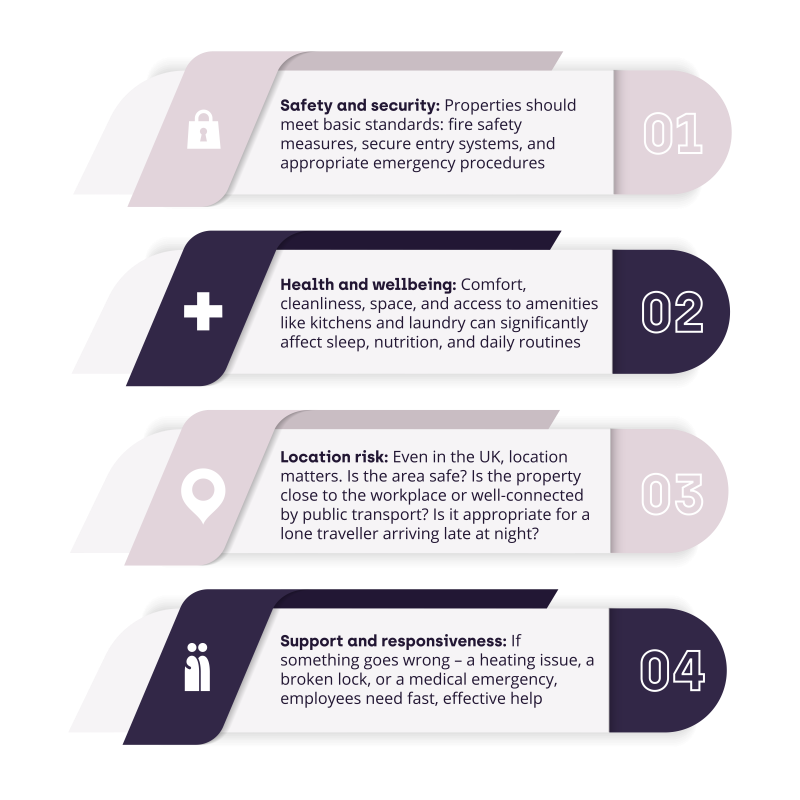
- Safety and security: Properties should meet basic standards: fire safety measures, secure entry systems, and appropriate emergency procedures.
- Health and wellbeing: Comfort, cleanliness, space, and access to amenities like kitchens and laundry can significantly affect sleep, nutrition, and daily routines.
- Location risk: Even in the UK, location matters. Is the area safe? Is the property close to the workplace or well-connected by public transport? Is it appropriate for a lone traveller arriving late at night?
- Support and responsiveness: If something goes wrong – a heating issue, a broken lock, or a medical emergency, employees need fast, effective help.
The benefits of a trusted accommodation provider
At Situ, our selection of accommodation partners is carried out to exacting standards by our experienced supply chain team. All new partners go through a rigorous onboarding process, which includes due diligence checks and the signing of our Partner Agreement. This agreement holds them to robust standards of quality and safety. We visit as many accommodation partners as possible, as well as accommodation in clients’ key locations.
We’ve also introduced a ‘Sustainability, Safety, and Security’ questionnaire to help identify preferred suppliers, and we can register your travellers with International SOS which provides reports showing where your employees are located.

International SOS, one of our travel-tech partners, provides medical and security services globally, focused on protecting and assisting people during health or security crises. It offers a range of services including medical, security, and logistics support. They operate with a large team of experts across 90 countries, offering support to ensure the safety and wellbeing of their clients’ workforce. For more information visit www.internationalsos.com.
Understanding the risks
Failing to take duty of care seriously can expose a business to a range of risks. These include:
- Health and safety risks: Inadequate fire safety, poor hygiene, lack of access to medical help.
- Reputational risks: If an employee is harmed while travelling for work and the organisation hasn’t taken reasonable steps to protect them.
- Legal and financial risks: Compensation claims or insurance complications if duty of care isn’t demonstrably upheld.
To fulfil duty of care, employers should avoid ad hoc lodging and instead use trusted providers with strong compliance processes. Even seemingly minor issues – like poor plumbing or lack of hot water – can have an impact on wellbeing and morale. By contrast, working with trusted accommodation partners gives travellers peace of mind. They can focus on their assignment, not on worrying about housing issues.
Inclusive duty of care: Considering the individual
In recent conversations with travel and mobility experts, Situ has seen a growing emphasis on inclusive duty of care – a shift towards recognising that safety isn’t one-size-fits-all.
Traditionally, duty of care has focused on the external risks associated with a destination – from political unrest to healthcare access or environmental conditions. While these remain important, inclusive duty of care brings another layer into focus: the traveller’s own characteristics and circumstances.
This approach encourages employers to assess both who is travelling and where they’re going. For example:
- A destination may pose specific risks to LGBTQ+ travellers.
- Women travelling alone might prefer extra location guidance or secure-entry accommodation.
- Health conditions or accessibility needs could make certain stays more challenging without the right facilities.
In short, inclusive duty of care means that travel managers should take individual wellbeing into account, not just assume that one policy fits all. That’s where thoughtful accommodation planning becomes even more valuable. With a clear understanding of employee preferences, priorities, and concerns, businesses can book stays that genuinely support the traveller – not just tick the compliance box.
What to look for in an accommodation partner
Not all accommodation suppliers are the same – and not all will help you meet your employer duty of care business travel UK requirements.
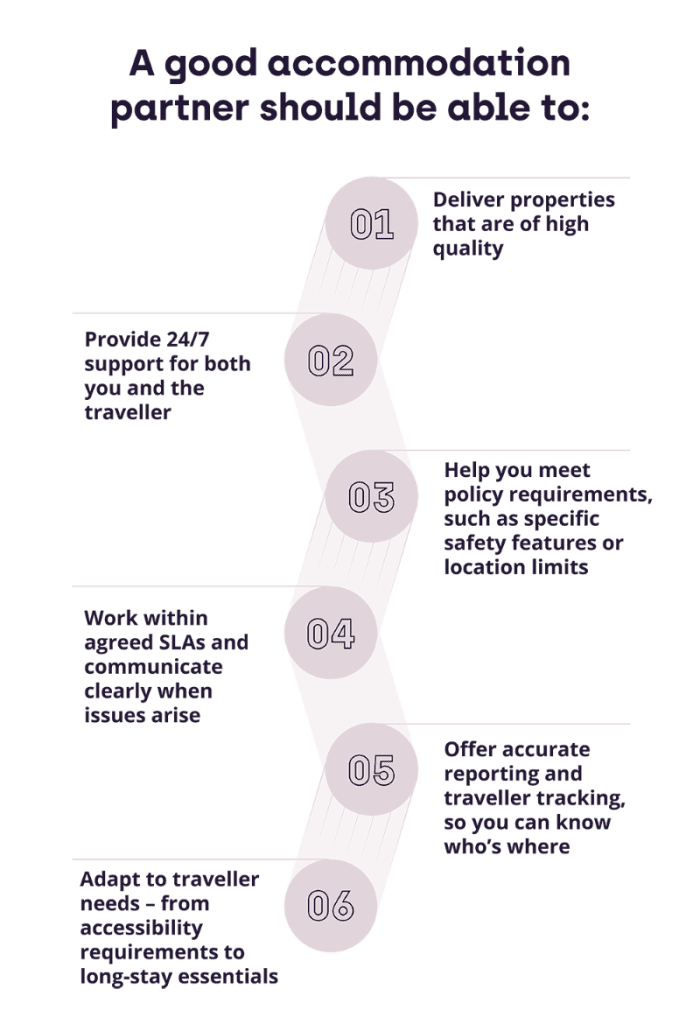
A good partner should be able to:
- Deliver properties that are of high quality.
- Provide 24/7 support for both you and the traveller.
- Help you meet policy requirements, such as specific safety features or location limits.
- Work within agreed SLAs and communicate clearly when issues arise.
- Offer accurate reporting and traveller tracking, so you can know who’s where.
- Adapt to traveller needs – from accessibility requirements to long-stay essentials.
Ultimately, partnering with experienced suppliers who prioritise both security and comfort gives employers another layer of duty-of-care protection. In practice, this means choosing agencies and networks that actively invest in safety and quality. For example, Situ’s accommodation solutions combine the privacy and flexibility of a home with the reassurance of professional standards – ideal for travelling individuals or relocating families.
Building accommodation into your travel policy
If you haven’t already, it’s worth reviewing your travel policy to make sure accommodation is properly covered.
Consider including:
- Minimum safety and quality standards for accommodation.
- Clear guidance on suitable locations (especially for higher-risk areas).
- A process for managing issues or complaints.
- A feedback loop to capture traveller experiences and concerns.
- If your business uses TMCs or relocation providers, make sure these standards are shared and followed across your supply chain.
Putting people first: The employee perspective
Duty of care doesn’t just tick a legal box, it shapes how employees feel. When business travel is done well, people feel supported, productive, and valued. When it’s done poorly, it can lead to stress, disengagement, or even refusal to travel again.
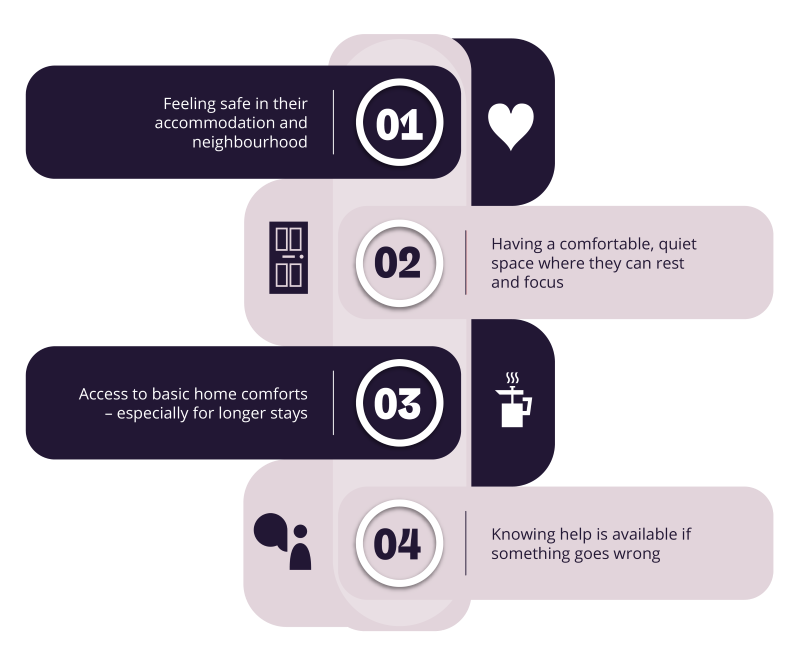
Things employees often care about include:
- Feeling safe in their accommodation and neighbourhood.
- Having a comfortable, quiet space where they can rest and focus.
- Access to basic home comforts – especially for longer stays.
- Knowing help is available if something goes wrong.
With serviced accommodation, many of these needs can be met more effectively than with traditional hotel stays or short-term rentals. At Situ, we find more and more companies are moving this way – and their travellers are happier for it.
Healthy habits and happy families
Healthy routines for better wellbeing
Travelling can easily disrupt healthy habits, especially when employees are juggling full schedules and unfamiliar surroundings. Encouraging travellers to maintain their usual routines can make a real difference to how they feel during their stay.
That might mean sharing tips on finding healthy food nearby, allowing time for movement and rest, or choosing accommodation that makes these things easier. For example, booking apartments with on-site gyms means travellers can de-stress and stay active without needing to navigate unknown areas or find time to travel off-site.
Many of Situ’s serviced apartments and aparthotels come with access to on-site gyms and wellness facilities – take a look at what else you can expect across our global accommodation network.

Supporting families during relocations
When it comes to relocations, one of the leading causes of failed assignments is family challenges. Moving is a big adjustment – not just for the employee, but for their partner, children, and wider support network.
That’s why employer duty of care in business travel (and relocation) should extend to making family transitions as smooth as possible. A stable, comfortable home environment gives employees the space to focus on their work, knowing that their family is settled and supported.
At Situ, we approach every relocation programme with care and attention to detail. For instance, when we supported the relocation of 30 families from Romania to Australia, we started with in-depth area research, explored requirements and preferences, and ensured our Guest Care Team was there to support throughout the process – delivering peace of mind from day one.
Final thoughts
Duty of care in business travel isn’t optional – and it doesn’t stop once the flight lands. Where your employees stay matters. It’s a core part of keeping them safe, happy, and ready to do their best work.
With the right accommodation partner, you can meet your responsibilities confidently and consistently – without creating extra admin for your teams or extra stress for your travellers.
Looking to improve your business accommodation strategy with duty of care in mind?
We’d love to help. Explore our Who We Work With page and see if we’d be the right fit for your business.