

When businesses arrange accommodation across the US and UK markets, the terminology can quickly become confusing. Terms like ‘long stay’, ‘extended stay’, or ‘notice to vacate’ can mean very different things depending on which side of the Atlantic you’re on. These misunderstands can be entertaining on occasion, but they shouldn’t be underestimated, as outlined by James Foice from ASAP:
‘We are still debating terminology that many regulators and governments don’t even understand themselves yet. What is a long-term stay? What is a short-term stay? They can’t define it. There is no definition. So, how they can legislate against something they don’t and can’t define is interesting to me. History tells us something quite important about that, if an industry doesn’t define itself clearly, someone else will eventually define it for them. And that’s where we need to really stick together as an industry across the ocean, across the world, as it’s not just the US and the UK.’

This quote comes from a recent Situ webinar, ‘Lost in Translation: The US & UK Accommodation Conversation’, for which we invited industry experts, Barbara Hale from dluxSuites and James Foice from ASAP, to join our Situ hosts, Jake Seage, Accounts Director, and Kristen Meglaughlin, Strategic Partnerships Director (Situ Americas). The goal: to explore the differences they experience between the US and UK serviced accommodation sectors, the difficulties and misunderstandings these variances cause, and what needs to be done to bridge the gap between these markets.
Contents:
- The nuances of long stay definitions
- The impact of accommodation models
- Notice to vacate: A critical terminology
- Navigating the challenges
- Serviced apartments vs corporate housing
- Exploring core differences in accommodation models
- The role of flexibility
- The call for regulation and industry challenges
- Addressing policymaker concerns
- Understanding the industry’s scope and data
- The need for unified data
- Conclusion: Bridging global perspectives
The nuances of long stay definitions
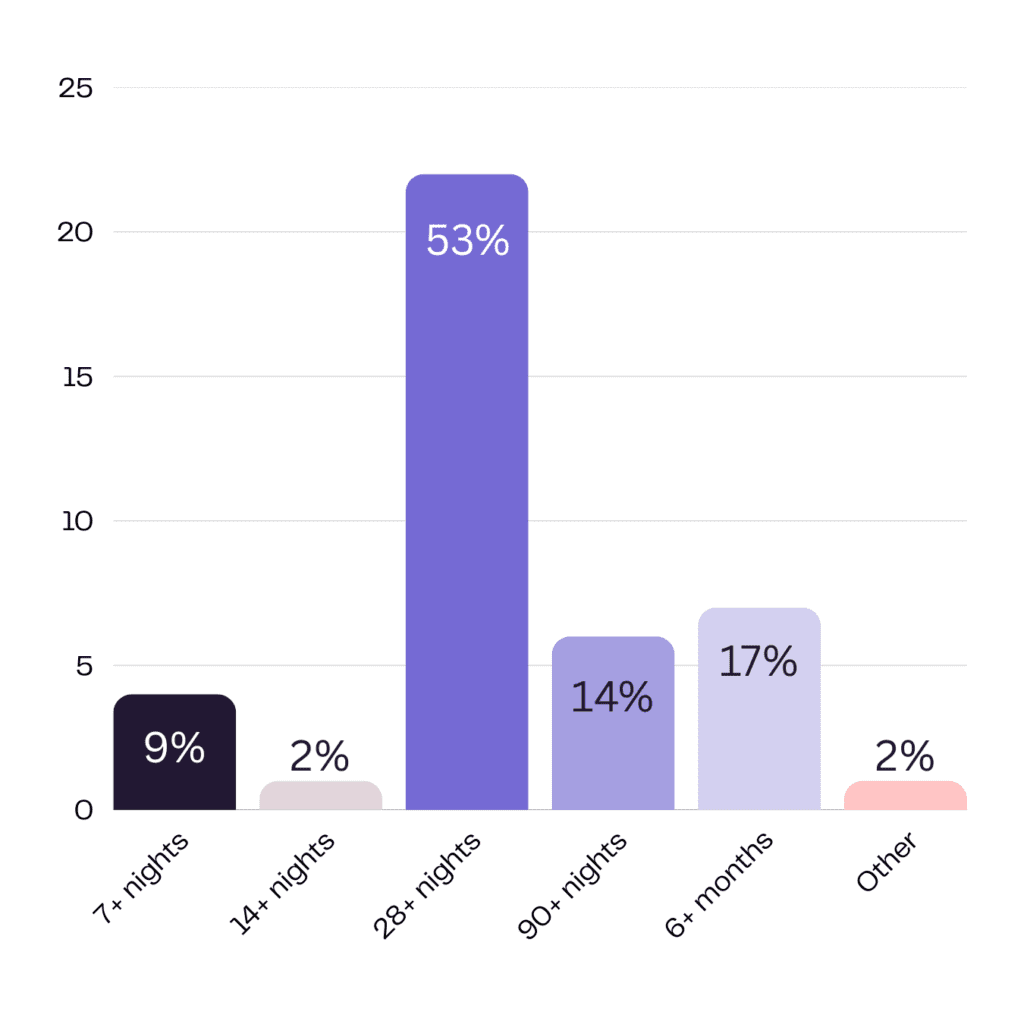
In the world of serviced accommodation, the term ‘long stay’ is often subject to interpretation. During our ‘Lost in Translation’ webinar, an audience poll revealed a range of perspectives on what qualifies as an extended stay. The majority of respondents settled on 28+ nights as the benchmark, yet the results highlighted differences between the US and UK markets.
As our US-based host Kristen pointed out:
‘In the US, I would definitely say we think six months on average [a long stay], sometimes it could be 90 days.’
Kristen Meglaughlin, Situ
However, our UK-based respondents had a different viewpoint, with 28+ nights being the norm. While one audience member commented that a ‘traditional long stay is 28+ nights when the VAT drops, but aparthotels change their pricing from transient to long stay after seven nights, so it is varied what exactly a long stay is.’ Calling attention to a further consideration, accommodation type.
As pointed out by Jake, who has extensive experience on the accommodation provider side following his time at Marriott, the UK can associate ‘extended stays’ with durations as short as five nights, a view influenced by the commonness of serviced apartments that offer greater flexibility and amenities compared to traditional hotels. On the contrary, in the US market, long stays typically align with standard lease agreements, meaning they’re closer to six months plus.
Results for ‘What do you consider a long stay?‘
The impact of accommodation models
The differences in defining long stays are deeply rooted in the distinct accommodation models that exist in each region. In the UK, a serviced apartment is often part of a larger development with consistent branding and operations, whereas in the US, corporate housing is more varied and can include anything from leased apartments to hotel-like services.
Notice to vacate: A critical terminology
Our speakers brought up a key source of confusion between US and UK conversations, understanding the terminology around ‘notice to vacate’ (NTV), which is crucial for both providers and clients in the serviced accommodation sector. Kristen highlighted the importance of this term, which can carry different implications depending on the region.

‘Notice to vacate is extremely important to understand on both sides because the UK have a completely different understanding, and also, especially on the America side, it can be a costly, costly misunderstanding.’
In the UK, the concept of NTV is less prevalent, as stays are often managed with more flexibility around departure dates. In contrast, the US model requires a formal NTV, often 30 or 60 days prior to the lease end date, to avoid financial penalties. This procedural necessity is deeply entwined with the leasing agreements typical in the US, where failing to provide adequate notice can result in extended financial commitments.
Navigating the challenges
For businesses operating transatlantically, understanding these nuances is critical. In the US, the rigid NTV requirements reflect a broader legal framework that governs corporate housing, whereas the UK’s more flexible approach can offer greater adaptability for short-term stays.
Serviced apartments vs corporate housing
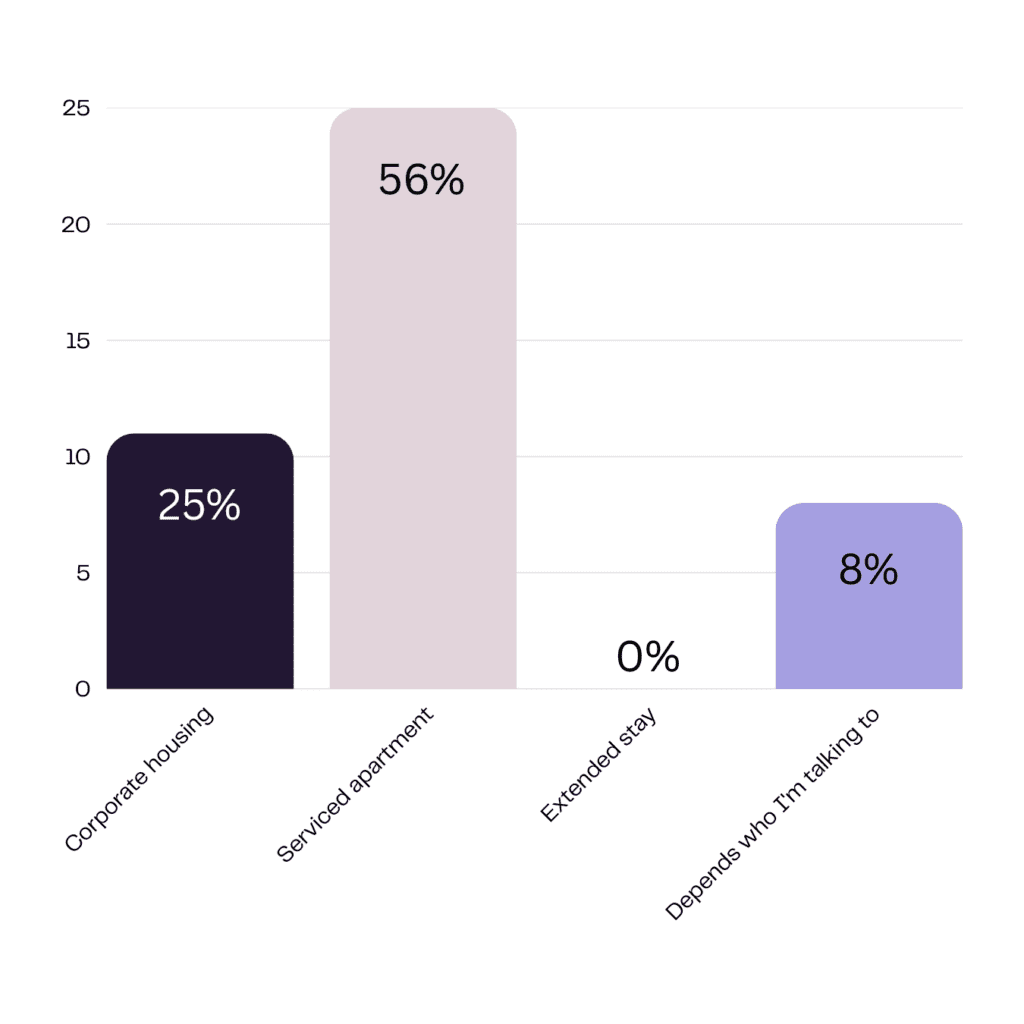
A further audience poll asked the question ‘In your market, which term is more commonly used?’ Results were as expected, with those in the UK market using ‘serviced apartment’ to describe their offering, while in the US, ‘corporate housing’ was the more common answer, with Kristen adding that ‘furnished housing’ and ‘temporary living’ are further frequently used terms. Other respondents noted that they alter their phrasing depending on who they’re speaking to.
Results for ‘In your market, which term is more commonly used?’
Exploring core differences in accommodation models
The webinar discussion also delved into the fundamental differences between accommodation models in the UK and US, shedding light on how these variances impact the serviced accommodation industry.
In the UK, serviced apartments often operate within a fixed inventory system, allowing for consistent quality and service. This model benefits from a degree of predictability in terms of availability and standardisation, appealing to business travellers seeking a home-like environment for short to medium-term stays.
In contrast, the US corporate housing model is highly varied, frequently involving lease agreements with residential apartment complexes. This approach provides a broader range of options but can introduce complexities related to lease terms and availability, particularly as providers navigate relationships with multifamily housing operators.
The role of flexibility
A significant challenge in the US market is the need for flexibility, especially post-COVID where many providers have become more risk adverse, and as demand for month-to-month arrangements has increased. Mirror leasing has emerged as a risk-averse strategy for corporate housing providers, allowing them to align lease terms with client needs, though often at the expense of this month-to-month flexibility.

The call for regulation and industry challenges
James Foice of ASAP underscored the necessity of regulation in the serviced accommodation sector, particularly in the UK, where the lack of clear guidelines poses challenges for policymakers and operators alike.
‘It is woeful the lack of understanding that we’re seeing from policymakers at the moment.’
James Foice, ASAP
The UK government is considering a statutory registration scheme aimed at bringing more transparency and control to the sector, especially concerning short-term rentals. This initiative seeks to differentiate professional operators from those operating in a more informal, potentially non-compliant manner.
Addressing policymaker concerns
The introduction of a registration scheme could help identify the scale of short-term rental operations, addressing concerns about overcrowding and the impact on housing availability. However, it also raises questions about the potential reduction in available accommodations for business travellers, who contribute significantly to local economies.

Want to hear the full discussion for yourself? Watch the webinar recording now.
Watch WebinarUnderstanding the industry’s scope and data
The webinar concluded with a discussion on the size and economic impact of the serviced accommodation industry.
Referencing a previous study that both Jake and James collaborated with Bonard on, ‘An Independent Review of the Role and Value of Serviced Apartments in the UK’, James noted how this research was able to assign billions to our industry, in terms of both ‘peripheral spend and direct spend’, and called for a further study across global markets to better represent the importance of the serviced accommodation sector.
‘You can imagine how powerful our collective argument is. So putting together a professional study that looks at both markets, possibly even Europe as well as the USA, North America, and any other of the big markets that our business travellers travel to; I think we have a compelling argument to talk about the legitimacy of our sector and how we know we need to be heard as an industry.’
James Foice, ASAP
The need for unified data
To effectively advocate for the industry and navigate regulatory landscapes, there is a pressing need for unified data and industry standards. This would not only enhance understanding among policymakers but also support the development of strategies that balance growth with compliance and sustainability.
Conclusion: Bridging global perspectives
The Situ webinar emphasised the importance of understanding regional differences in the serviced accommodation sector, from defining long stays to navigating regulatory challenges. As the industry continues to evolve, collaboration and communication across borders will be essential in fostering a unified approach to terminology, operations, and advocacy.
In bridging these global perspectives, the sector can better serve its diverse clientele, ensuring a seamless and enriched experience for business travellers worldwide.
The final message is clear: collaboration across the accommodation industry globally is integral to its continuing success.