


Creating a temporary accommodation budget can seem daunting, however, with the right considerations in place, it becomes far easier to plan accurately and avoid unexpected costs.
At Situ, we have been supporting businesses and RMCs with their accommodation needs for nearly two decades. Below, we break down the key factors that will help you build a budget that works for both your business and your assignees.
Contents:
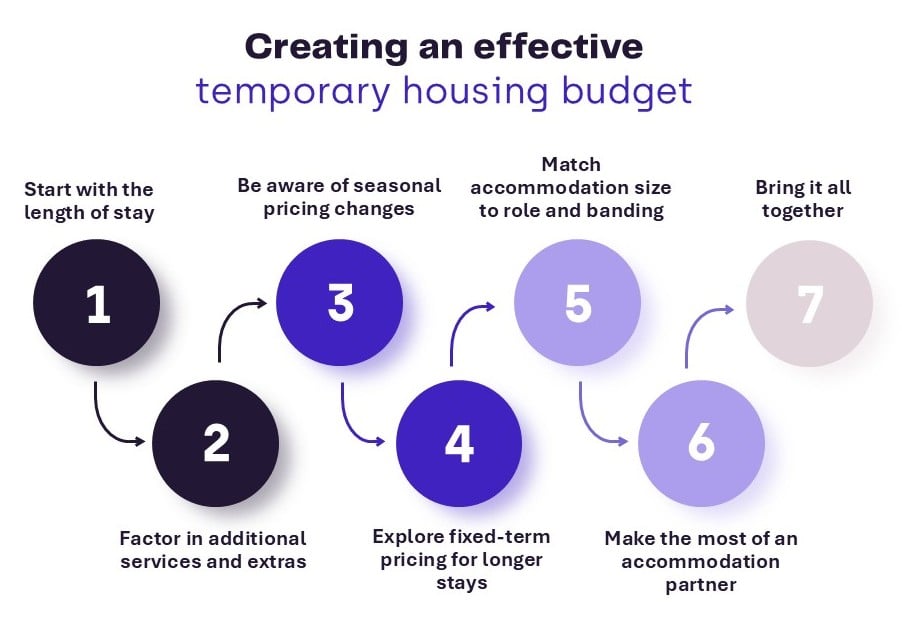
- Start with the length of stay
- Costs you might not have considered
- Factor in additional services and extras
- Be aware of seasonal pricing changes
- Explore fixed-term pricing for longer stays
- Match accommodation size to role and banding
- Make the most of an accommodation partner
- Conclusion: Bringing it all together
Start with the length of stay
The length of stay should always be your first consideration, as it has the biggest impact on overall cost.
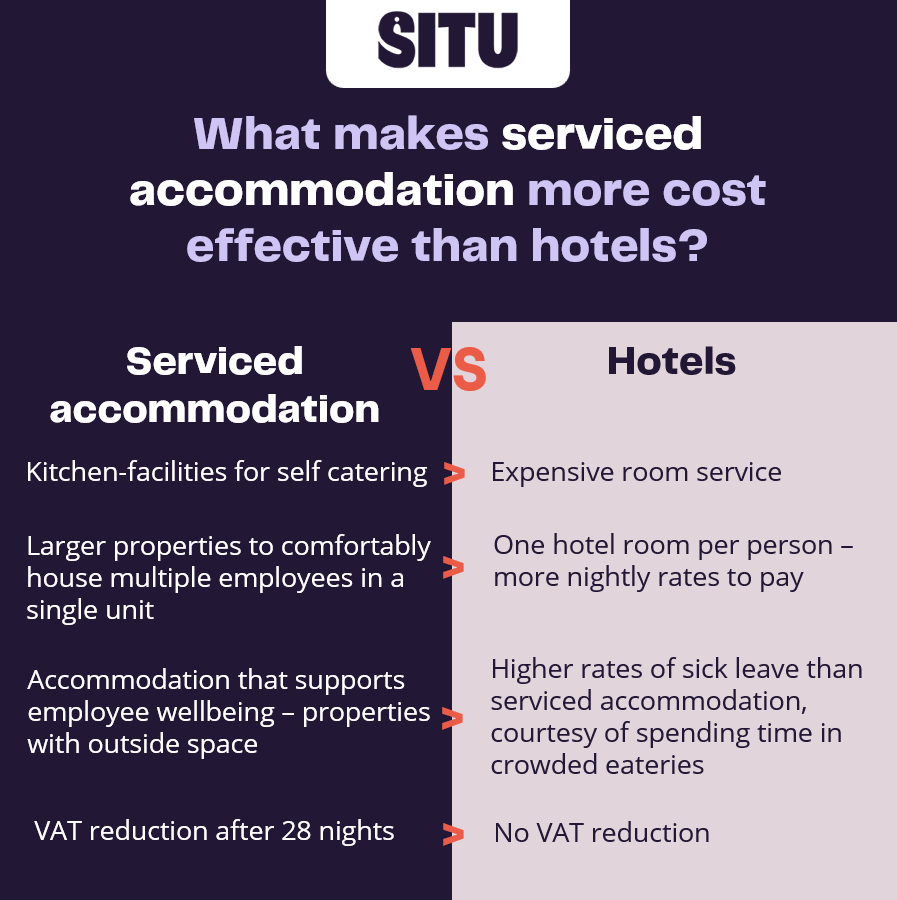
While hotels and serviced accommodation can appear similar on a nightly rate, the difference becomes clear for mid to long-term stays. Serviced accommodation often delivers better value over time thanks to practical features such as fully-equipped kitchens and on-site or in-apartment laundry. These amenities reduce daily living expenses, cutting down on the need for restaurant meals and external services.
It’s also worth noting that in the UK, the VAT for serviced accommodation drops after 28 nights from 20% to 4%, a further reason this housing type becomes more cost effective than hotels for longer stays.
If an assignment is likely to last weeks or months, planning around the full duration from the outset will help you choose accommodation that supports both comfort and cost control.
Cost savings you might not have considered
When arranging housing for previous clients, we spotted a reduction in sick leave for guests staying in serviced accommodation compared to hotels, due to reduced exposure to sickness bugs in hotel receptions and outside eateries.
Further research demonstrated significant cost reductions for relocating families staying in serviced accommodation over hotels in six key UK locations. For instance, a saving of 65% was seen for an Edinburgh stay.
Details that can make a substantial impact such as these are important considerations for your budget planning.
Factor in additional services and extras
Beyond the nightly rate, additional services can quickly affect your budget if they are not accounted for early.
Parking is a common example, particularly in city locations where fees can be high. Pet-friendly accommodation can also come with extra charges.
If you’ve decided on rental accommodation for your assignee, you will need to consider services that – unlike with serviced accommodation – don’t usually come as standard, including Wi-Fi, gas/electric, water bills, etc. which will also require contracts to be signed.
It is important to clearly define which costs will be covered by the company and which, if any, will fall to the employee. This clarity avoids confusion later and ensures your budget reflects the true cost of the stay.
Be aware of seasonal pricing changes
Just like hotels, serviced accommodation pricing can vary throughout the year.
Peak seasons, major sporting events, and international conferences often drive prices up, sometimes significantly. These fluctuations can have a real impact on corporate accommodation budgets, particularly for longer stays.
Working closely with your accommodation provider allows you to anticipate these changes. With early visibility, you can plan ahead and adjust budgets before costs rise, rather than reacting once prices have already increased.
Explore fixed-term pricing for longer stays
For extended assignments, there may be opportunities to negotiate fixed-term costs.
Agreeing a set rate in advance can provide valuable cost certainty and protect your budget from seasonal increases. This approach works best when discussions happen early and expectations are clearly defined on both sides.
Clear communication helps ensure the provider understands your programme requirements, while you gain predictable pricing that supports long-term planning.
Match accommodation size to role and banding
Accommodation requirements are rarely one-size-fits-all.
Senior executives may want larger or more premium spaces, while junior staff may be well suited to more compact options. These variations should be carefully considered and aligned with internal policies around role, seniority, and budget limits.
By planning accommodation size and specification according to position and banding, you can balance employee experience with responsible cost management.
Make the most of an accommodation partner
Sticking to your budget is far easier with an accommodation partner to support your temporary housing decisions. At Situ, we’re unique in our industry because of our Managed Partner Network – the foundation of our global accommodation offering.
For a provider to reach managed status with us, they must meet strict requirements, including having robust commercial agreements in place. This means that clients can rely on us to secure the very best rates – particularly when bookings are made at volume – or to build them managed housing programmes that suit their business goals.
Speak to our team to see how we can support your temporary housing programme.
Conclusion: Bringing it all together
An effective temporary accommodation budget is built on understanding the full picture. Length of stay, additional services, seasonal pricing, negotiated rates, and accommodation size all play a part.
By taking a structured approach and working closely with trusted accommodation partners, you can create budgets that are accurate, flexible, and fit for purpose. This not only protects your costs but also supports a better experience for employees during their stay.