


For temporary housing programmes to succeed worldwide, organisations need more than just accommodation in multiple locations. They need consistency, coverage, and confidence across every destination.
That requires a deep understanding of local regulations, housing expectations, market conditions, and traveller needs. From tax rules to property standards, global mobility teams face a wide range of variables that can affect both employee experience and programme cost.
That’s why companies benefit from working with an accommodation partner who can offer both breadth and depth – combining global reach with local expertise.
In this blog, we’ll explore why these factors matter, what global nuance looks like in practice, and how the right housing partner can support your programme at every stage.
Contents:
- Understanding global nuance in corporate accommodation
- Global supply chain – easy to scale, consistent experience for travellers
- Breadth AND depth – strategic expansions
- The importance of service – follow the sun support
- Why global reach matters in corporate housing programmes
- Conclusion
Understanding global nuance in corporate accommodation
Corporate accommodation varies significantly around the world, influenced by local customs, legal requirements, and market conditions. A trusted accommodation partner who understands these differences can guide you effectively.
For instance, in the UK, VAT costs on accommodation drop significantly after 28 nights, from 20% to 4%. This can impact budgeting for longer stays, depending on a company’s VAT reclamation policies. In Paris, it is common to encounter single-glazed windows in older apartments, which may affect comfort and noise levels. In some European countries, apartments may not have air conditioning, which can be challenging during the summer months.
In the US, assignees may be required to sign a lease, a practice that is less common in other regions. Conversely, homes in Europe are generally smaller than those in the US, which is an important factor in managing expectations. Additionally, some European cities impose a city tax on accommodation, calculated per occupant rather than per booking, which is an important consideration for budget planning.
Understanding local regulations and tenant rights is crucial. In some countries, regulations affect lease flexibility and the availability of certain amenities. For example, many European cities have strict rules around short-term rentals, which can influence both availability and cost. It is also important to consider the surrounding community, including safety, local character, and access to recreational spaces. A positive environment can greatly improve the overall living experience for assignees.
These variations highlight the value of a knowledgeable partner who can provide location specific insight, helping to ensure assignees are comfortable and programmes remain cost effective.

Global supply chain – easy to scale, consistent experience for travellers
Having a few trusted properties in major cities is a good starting point. But what happens when you need to send employees to more remote or less serviced locations?
Mobility doesn’t always follow predictable patterns. Assignments may arise in emerging business hubs, rural project areas, or destinations where quality accommodation is harder to source.
That’s where a strong global supply chain becomes essential.
A housing partner with worldwide coverage can support organisations wherever their people need to be, without compromising on standards. Just as importantly, they can help ensure that travellers receive a consistent experience across regions.
At Situ, we hold our accommodation network to high standards, working closely with partners to deliver the same core expectations – comfort, safety, and service – regardless of location.
Breadth AND depth – strategic expansions
It’s easy to assume that having apartments available in many cities automatically equals a global network.
In reality, the value goes much deeper.
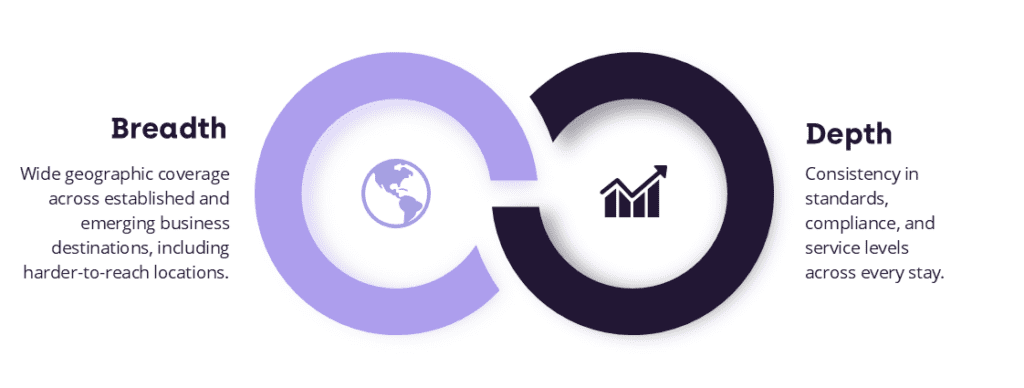
A strong accommodation network combines:
- Breadth – wide geographic coverage across established and emerging business destinations, including harder-to-reach locations
- Depth – consistency in standards, compliance, and service levels across every stay
Corporate travel and global mobility teams need both.
Breadth ensures employees can be supported wherever work takes them. Depth ensures those employees receive a safe, reliable, and comfortable experience each time.
That’s why Situ has established a managed Partner network built for long-term programme success.
We take pride in the strength of our accommodation partnerships – spanning over 144 countries – and in the continual, strategic growth of that network.
This expansion isn’t just about adding more cities to the map. It’s about providing dependable coverage across the world’s busiest business hubs as well as in more isolated destinations.
For example, we’ve supported clients operating in rural locations where accommodation options were limited and fragmented, including assignments near the Arctic Circle.
The importance of service – follow the sun support
Service is just as critical as sourcing for global accommodation programmes.
Employees may arrive in a new country outside local working hours. Travel plans can change suddenly. Issues can arise that require immediate attention, whether related to access, safety, or comfort.
That’s why mobility teams need a partner who can provide responsive support across time zones.
A ‘follow the sun’ service approach ensures that wherever your travellers are in the world, help is available when it matters most.
This level of care improves assignee confidence, reduces stress during transitions, and supports duty of care responsibilities for organisations.
Why global reach matters in corporate housing programmes
A global network is a strategic advantage for corporate housing programmes.
Here’s why:
- Consistency of experience – Employees know they can expect the same high standard of accommodation, regardless of location.
- Duty of care and compliance – Partners with global knowledge can advise on local regulations and safety expectations.
- Efficiency and savings – Working with one provider across regions reduces fragmented sourcing and improves cost oversight.
- Scalability – As organisations expand into new markets, they need housing support that grows with them.
At Situ, our goal is to align our accommodation network with the evolving needs of our clients, supporting mobility programmes that are efficient, resilient, and employee-focused.
Conclusion
A global accommodation network isn’t just about having apartments in many places. It’s about consistency, safety, scalability, and employee experience.
For corporate mobility teams, choosing a partner with both breadth and depth can transform housing programmes, reducing complexity while improving traveller outcomes.
At Situ, we believe every traveller should feel at home, whether they’re in the centre of a capital city or in a rural location far from it.
If you’d like to explore how our global network can support your corporate housing programme, get in touch with our team today.