


When an employee accepts an international assignment, their experience does not begin with their first day in the new office – it begins with their first steps into their new home. Accommodation often forms the initial impression of a new location and can have a lasting impact on how smoothly an individual, or family, settles in. Get it right, and employees feel valued, supported, and able to perform at their best. Get it wrong, and even the most well-designed relocation can be cut short.
A joint research initiative conducted by Sterling Lexicon and Deloitte found that improving employee experience was the top priority for global mobility professionals in 2025, with 66% of respondents putting it in the top spot. This article explores why accommodation is central to employee experience and how global mobility managers can make informed choices that benefit both employees and the wider organisation.
Sections:
- The link between employee experience and accommodation
- What employees really need in mobility accommodation
- Practical steps for mobility managers
- Balancing employee preferences with business goals
- The role of the right partner
- Conclusion
The link between employee experience and accommodation
Accommodation is far more than a roof over someone’s head. For an assignee moving to a new country, it represents stability, safety, and a sense of home. The right property helps employees quickly establish routines, feel comfortable, and maintain their sense of wellbeing.
First impressions matter. An employee who arrives at a well-equipped, welcoming apartment or house is more likely to begin their assignment with confidence and positivity. By contrast, unsuitable accommodation can create stress, frustration, and distraction – all of which affect engagement and productivity.
“At Situ, we don’t just arrange places to stay, we help create experiences that make people feel genuinely cared for. I’m proud of how our team takes the time to understand each client and traveller, working closely with our brilliant Partners to get the details right. From arrival to departure, wherever in the world they are, our guests should feel comfortable, confident, and completely supported and that’s what drives us every day.”
Abbie Erdbrink, Head of Partnerships and Guest Experience at Situ

What employees really need in mobility accommodation
Every relocation is different, but certain needs remain consistent:
- Comfort and liveability – employees should feel at home, with the ability to cook, relax, and work privately if needed. Self-catering facilities and ample space make a huge difference.
- Safety and security – trusted properties in safe areas, backed by reliable support, give employees peace of mind and demonstrate that duty of care is a priority.
- Flexibility and choice – assignments vary in length, and personal situations differ. Options for short- and long-term stays, family accommodation, or pet-friendly homes ensure employees’ real lives are taken into account.
- Connectivity and convenience – access to public transport, proximity to the workplace and schools, and nearby shops or services all support day-to-day life.
- Support for wellbeing – whether it is quiet surroundings, fitness facilities, or green spaces, small details can help employees maintain their health and balance.
By recognising these needs, organisations can select accommodation that makes employees feel looked after rather than just placed.
For one of our global mobility clients, we helped relocate thirty assignees and their families from Romania to Australia, paying careful attention to each assignee’s preferences, in order to find accommodation that contributed to a positive and ultimately successful experience. For these assignees, this meant proximity to parks, as well as a particular focus on excellent Wi-Fi and a smooth check-in process – find out more about this global housing programme in the case study video below – considerations such as these ensure assignees feel their experience is being taken into account.
Practical steps for mobility managers
To put employee experience front and centre in your global mobility programme, consider the following steps:
- Understand employee profiles – gather details about who is relocating, whether solo or with family, and what matters most to them. You can find out more about what information to include in our guide to inclusive duty of care. For employees with families, providing extra support for them will be a big help.
- Simplify communication – these people are uprooting their lives, you will see better engagement if you prioritise empathy, flexibility, and clarity. Avoid jargon and keep things human.
- Cultural training – provide clear information that assignees will need to know about their new area. Logistics are integral, but don’t get too caught up and forget this equally important factor.
- Create clear but flexible policies – establish guidelines that support business objectives while still allowing room for personal needs. Example: A policy might require accommodation within 30 minutes of the office, but allow exceptions for assignees with families who require family-friendly residential areas further afield.
- Gather feedback – ask employees about their accommodation experience to improve future programme decisions.
- Work with trusted providers – choose housing partners who can offer scalable service, extensive global coverage, and local market expertise (like Situ!), ensuring consistency across programmes.
These steps not only support employees but also strengthen the overall effectiveness and replicability of a mobility programme.
Balancing employee preferences with business goals
Of course, accommodation choices are not made in isolation. Global mobility teams must weigh employee preferences against company objectives. Key considerations include:
- Cost control vs. quality of stay – providing suitable accommodation without overspending requires careful planning, data-driven decisions, and excellent partner relationships.
- Duty of care – ensuring properties meet safety standards and compliance obligations is non-negotiable.
- Policy alignment – accommodation should fit within mobility policies but leave room for flexibility, so employees feel supported as individuals.
- Transparency – accurate reporting on spend, usage, and outcomes helps businesses demonstrate value and adjust programmes where needed.
The most effective programmes find a balance where employees feel cared for, and the organisation maintains control and clarity.
The Situ experts are well-positioned to assist here – our close relationships with our managed accommodation Partner network mean we can negotiate the best rates for clients, and work within any budget; while our stringent quality standards mean clients can be confident that they are meeting duty of care requirements and prioritising employee experience.
And with our enterprise-grade booking platform, Xenia, mobility managers get access to a Databricks-powered data platform enabling real-time segmentation, making transparent reporting easier than ever.

The role of the right partner
We often hear about companies relying on popular peer-to-peer booking platforms for their employees’ accommodation, and subsequently facing last-minute cancellations, inaccurate property descriptions, and inconsistent quality.
Finding the right accommodation partner can remove this uncertainty. An experienced provider offers a reliable service, but more than that, they act as an adviser, helping mobility teams navigate complex requirements while prioritising the human experience.
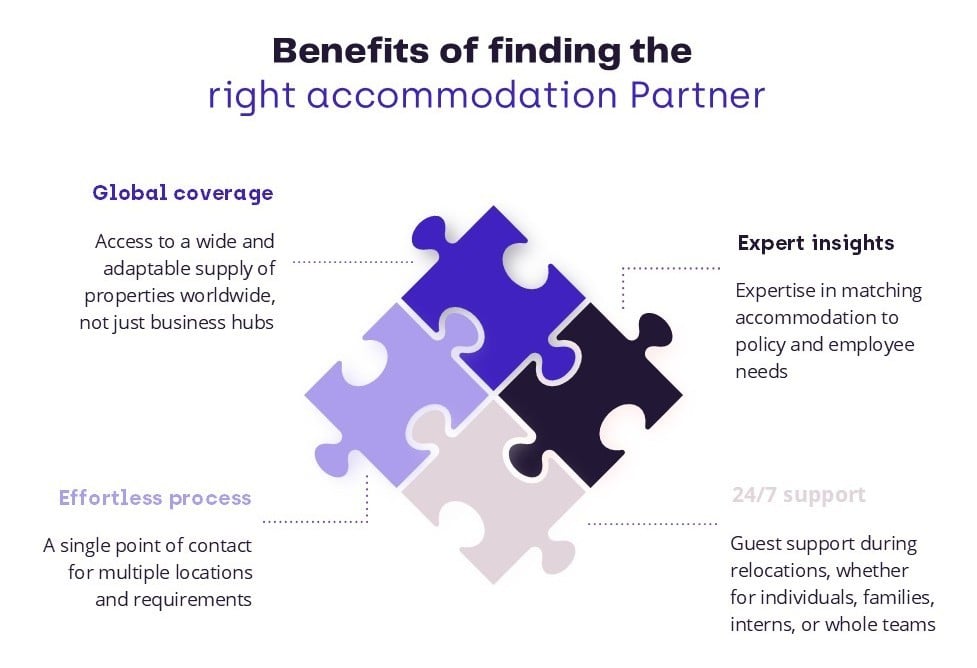
Benefits of the right partner include:
- Access to a wide and adaptable supply of properties worldwide, not just business hubs.
- Expertise in matching accommodation to policy and employee needs.
- A single point of contact for multiple locations and requirements.
- Guest support during relocations, whether for individuals, families, interns, or whole teams.
By working with specialists, organisations can provide accommodation solutions that are practical for the business and positive for the employee. The benefits of this type of partnership cannot be undervalued, get in touch with the Situ team for further detail on how we can support your goals.
Conclusion
Employee experience is at the heart of every successful global mobility programme, and accommodation plays a leading role in shaping it. By providing safe, comfortable, and flexible living spaces, organisations can help employees feel settled, motivated, and ready to deliver on their assignments.
At the same time, the right accommodation solutions support business goals, from duty of care to cost management. It is about creating an environment where both employees and organisations thrive.
If you would like to explore how Situ can support your mobility programme with accommodation that works for both your employees and your business, get in touch with our team today.